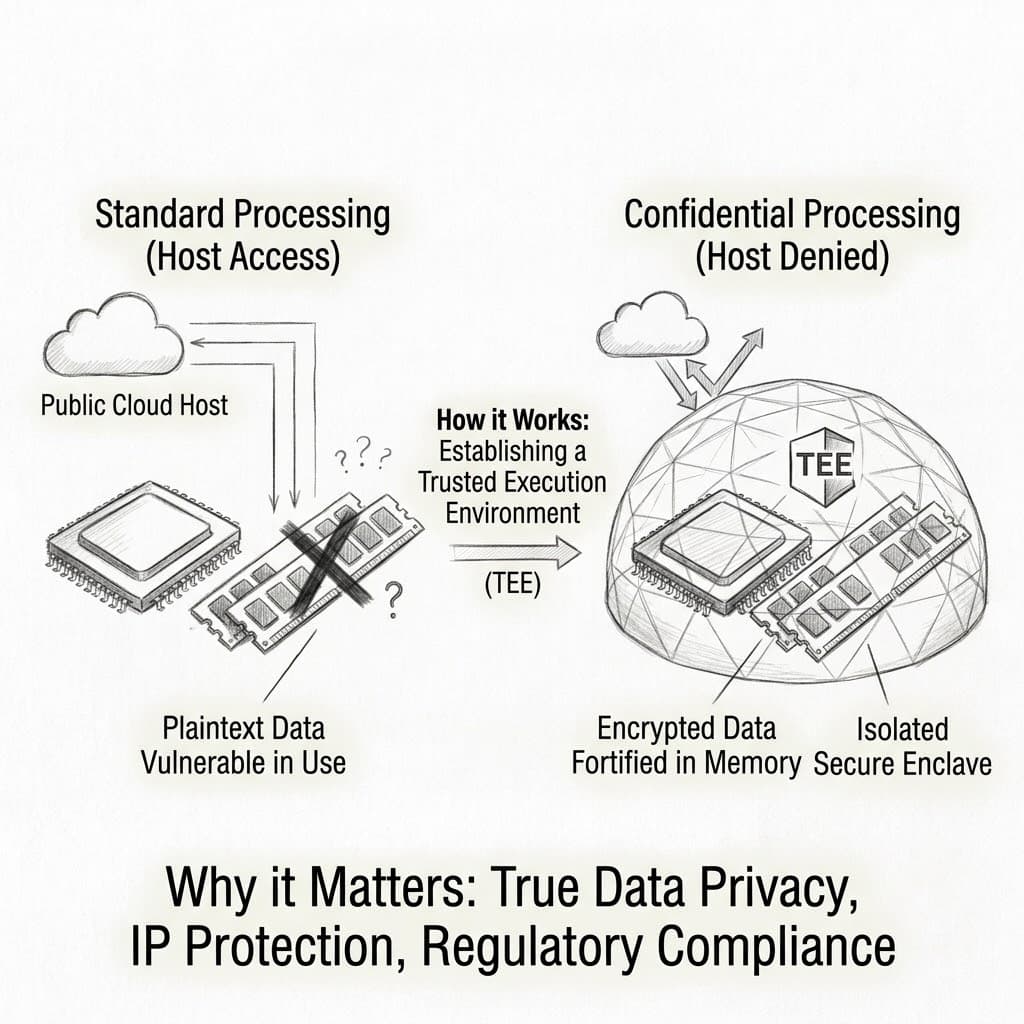
Confidential computing is the technology that keeps data encrypted even while it is being processed. It closes the gap left by encryption at rest and in transit, protecting the one state of data that has historically been left exposed: data in use.
Sensitive information moves through three states. At rest, it sits on disk or in storage. In transit, it travels across networks. In use, it is loaded into memory and actively processed by a CPU. Encryption has long protected the first two states, but once data is decrypted for processing it becomes readable to the operating system, the hypervisor, and anyone with privileged access to the machine. Confidential computing changes that by keeping data encrypted inside a protected region of the processor, even while computation happens on it.
At the foundation of confidential computing are trusted execution environments (TEEs), hardware-backed regions that isolate code and data from the rest of the system. Implementations such as Intel SGX and AMD SEV are widely deployed examples. TeyzSec builds on this foundation by combining hardware-rooted trust with continuous runtime verification, so sensitive workloads stay protected in untrusted environments such as shared clouds and multi-tenant infrastructure.